Exhibit 01 Terminal narrative · computing history
RESIDUES
The puzzle stays precise. The world around it does not.
A Rust terminal game that reconstructs six ideas from computing history inside a fictionalized portrait of Alan Turing’s failing mind.
- Created by
- İclal Doğan
- Format
- Runs locally · terminal
- Built with
- Rust · ratatui · crossterm
External links open in a new tab. Development stories may contain spoilers.
I The question
Can the act of operating a machine make computing history felt rather than merely explained—and hold technical clarity beside human tragedy?
Inside the experience
Operate the idea
Six acts put real computational mechanisms under your hands: punched cards, difference engines, assembly, Boolean gates, information channels and a Turing machine. These are playable models, not historical trivia questions.
Bright puzzle, dark undertow
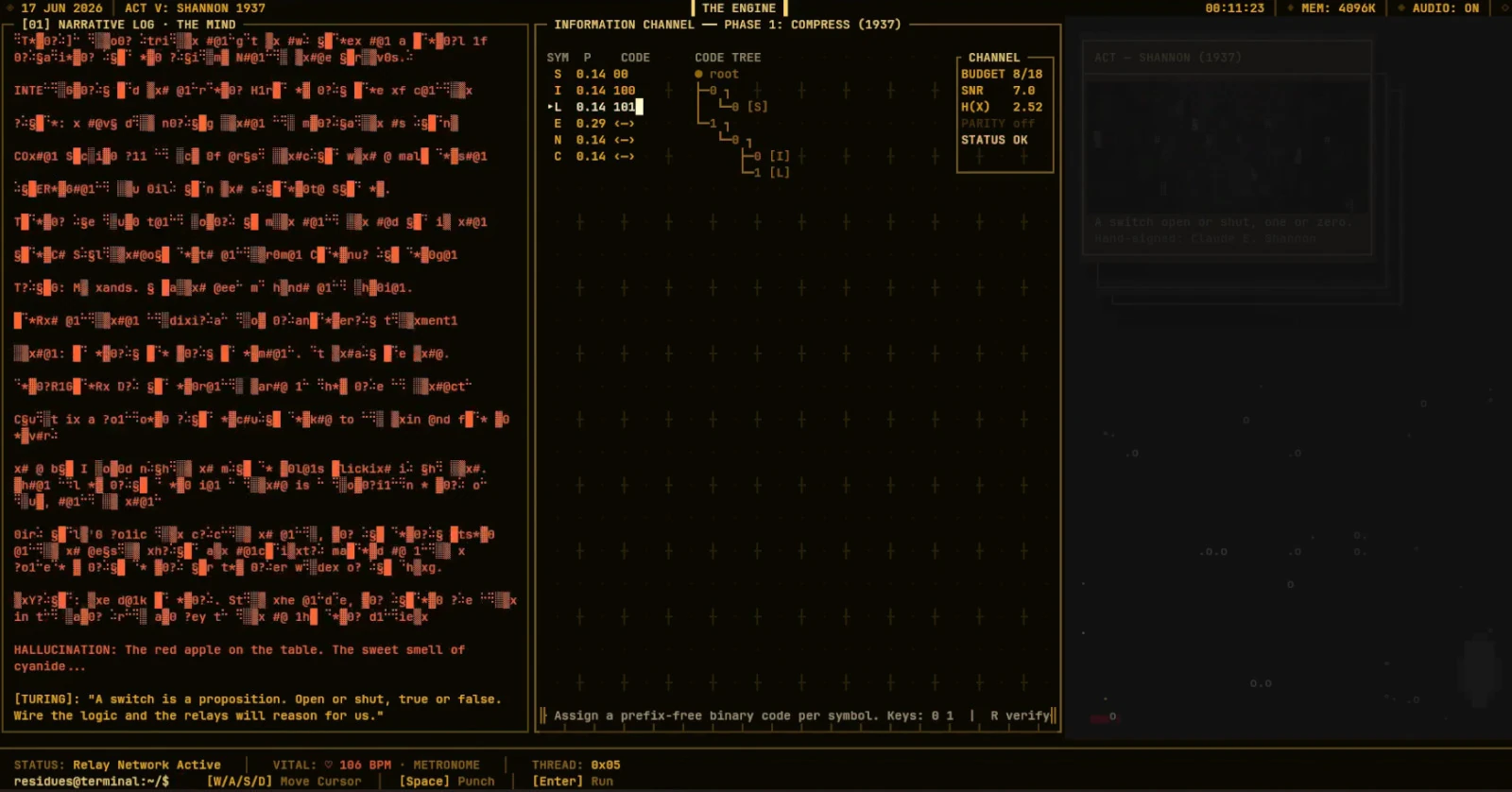
A three-panel terminal holds the narrative log, the working machine and a candlelit dossier. The candle diminishes, text decays and the heartbeat changes while the puzzle still demands an exact answer.
Memory has a rhythm
Keyboard input drives the machines. Prerecorded voices, binaural whispers, rain and a heartbeat metronome give the amber interface a physical sense of time. Headphones add detail; audio is not required to play.
Six machines, six ideas
I · Jacquard
Punch an 8×8 bit matrix and discover a reusable, looping deck of cards.
II · Babbage
Build a method-of-differences sequence and stagger delay buffers to propagate carries.
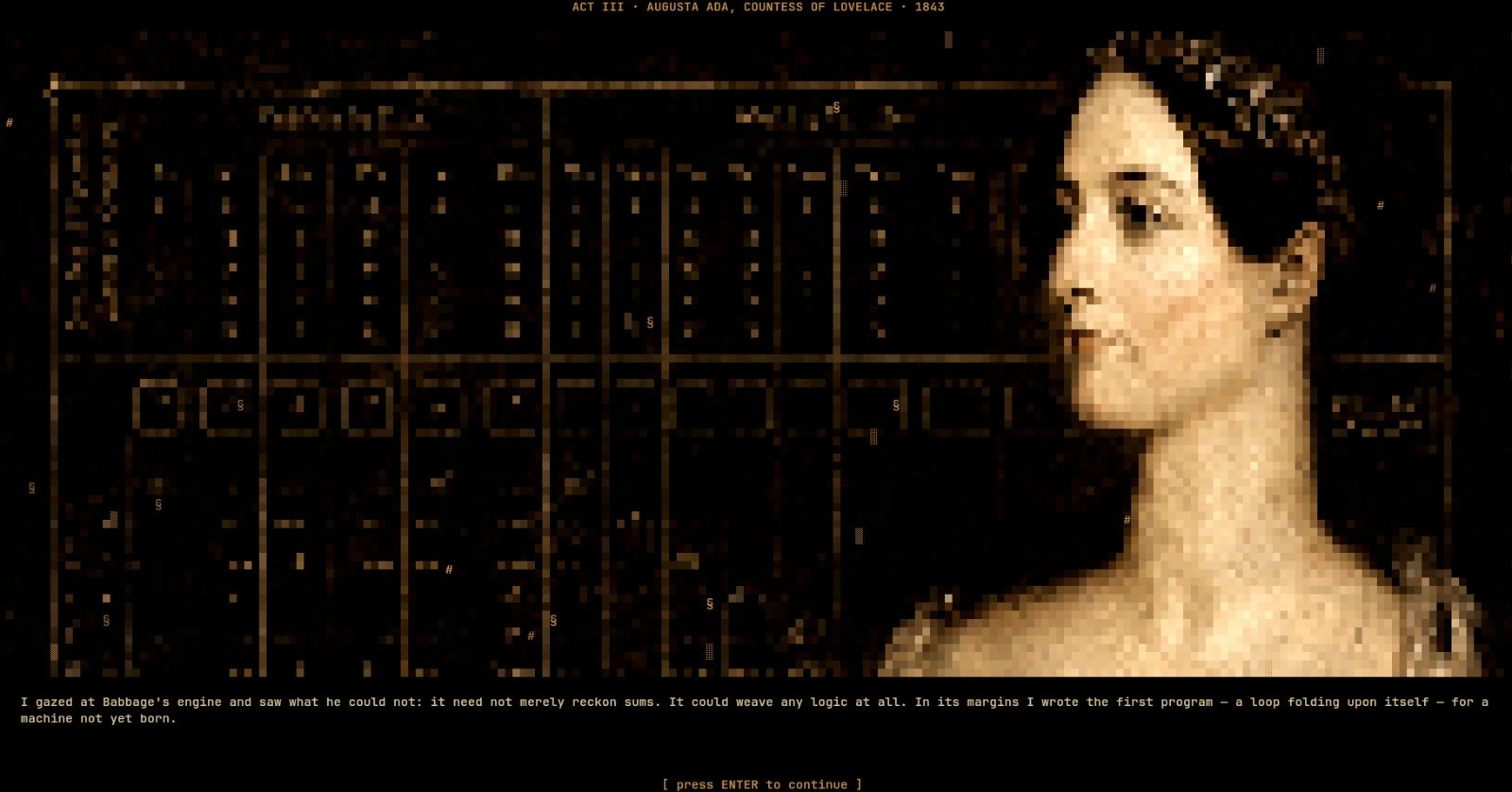
III · Lovelace
Program a three-register machine with seven instructions, then use loops to calculate a checksum.
IV · Boole
Steer AND, OR, XOR and NOT gates toward a checksum, even when the displayed output becomes unreliable.
V · Shannon
Fit prefix-free codes into a limited channel, then protect against bit flips with Hamming(7,4) parity.
VI · Turing
Operate a tape and transition table to stabilize residues from the earlier machines.
How it was built
Rust owns the simulation and terminal event loop. ratatui provides layout and rendering; crossterm handles terminal input. A truecolor half-block image renderer brings portraits into the same character-based surface.
Audio is handled by spawning external OS players rather than an embedded audio crate. The engine probes mpv, ffplay and mpg123, and remains playable without them. ElevenLabs supplied prerecorded voices and whispers; this game does not make live AI calls during play.
Engineering decisions
Separate truth from its display
The Boole act can corrupt the visible output while preserving the underlying gate result. The narrative’s uncertainty does not turn the computational model into arbitrary noise.
Use the terminal as material
Portraits, candlelight and dossiers share a truecolor character surface. The constrained medium is part of the art direction, rather than a temporary substitute for a graphics window.
Let audio fail quietly
External-player discovery keeps the dependency surface small. Missing audio support removes sound rather than blocking the puzzles.
From the actual experience
A machine learning how to forget.
Project notes
Before you enter
This is a local keyboard-driven terminal game, not a browser demo. The repository provides build and launch instructions. Run from the repository root so audio and image paths resolve.
A truecolor terminal is recommended. Linux is the primary tested platform; the README describes macOS as expected to work and Windows as untested / unsupported. These platform claims come from the author, not new cross-platform testing here.
Watch the playthrough
The external playthrough includes spoilers.